Occupied Building Reroofing in Clearwater, FL

Reroofing in Clearwater, FL while tenants, patients and customers stay inside: phased tear-off, dust and noise control, same-day dry-in and storm timing.

Most problems on an occupied reroof show up inside the building, not on the roof. A tile drops out of a ceiling. A tenant finds dust on a desk. A stockroom gets wet because a section stayed open overnight. The roof itself may be going on perfectly, and the project still feels like a failure to the people underneath it.

Here is how it works. A reroof is a series of small openings and closings. The job is to keep each opening short, keep the debris away from people, and keep the building running in Clearwater, FL while it happens.

Trouble starts indoors

Trouble starts indoors

Step one is the tear-off. Pulling an old membrane loosens grit, insulation dust and fasteners. If the deck below has gaps, or the ceiling is a suspended tile grid, some of that falls through.

Step two is the overnight opening. A section stripped late in the day and left uncovered is the single biggest risk to the interior. One storm cell, one forgotten corner, and water reaches the ceiling.

Step three is the air. Adhesives, primers and hot-applied materials give off fumes that rooftop intakes can pull straight into the ductwork. A tenant who smells the roof will call before the crew ever sees a problem.

Step four is the noise. Gas-powered cutters, carts and fastener guns carry through a deck, and a quiet office or exam room feels every minute of it.

Work in small sections

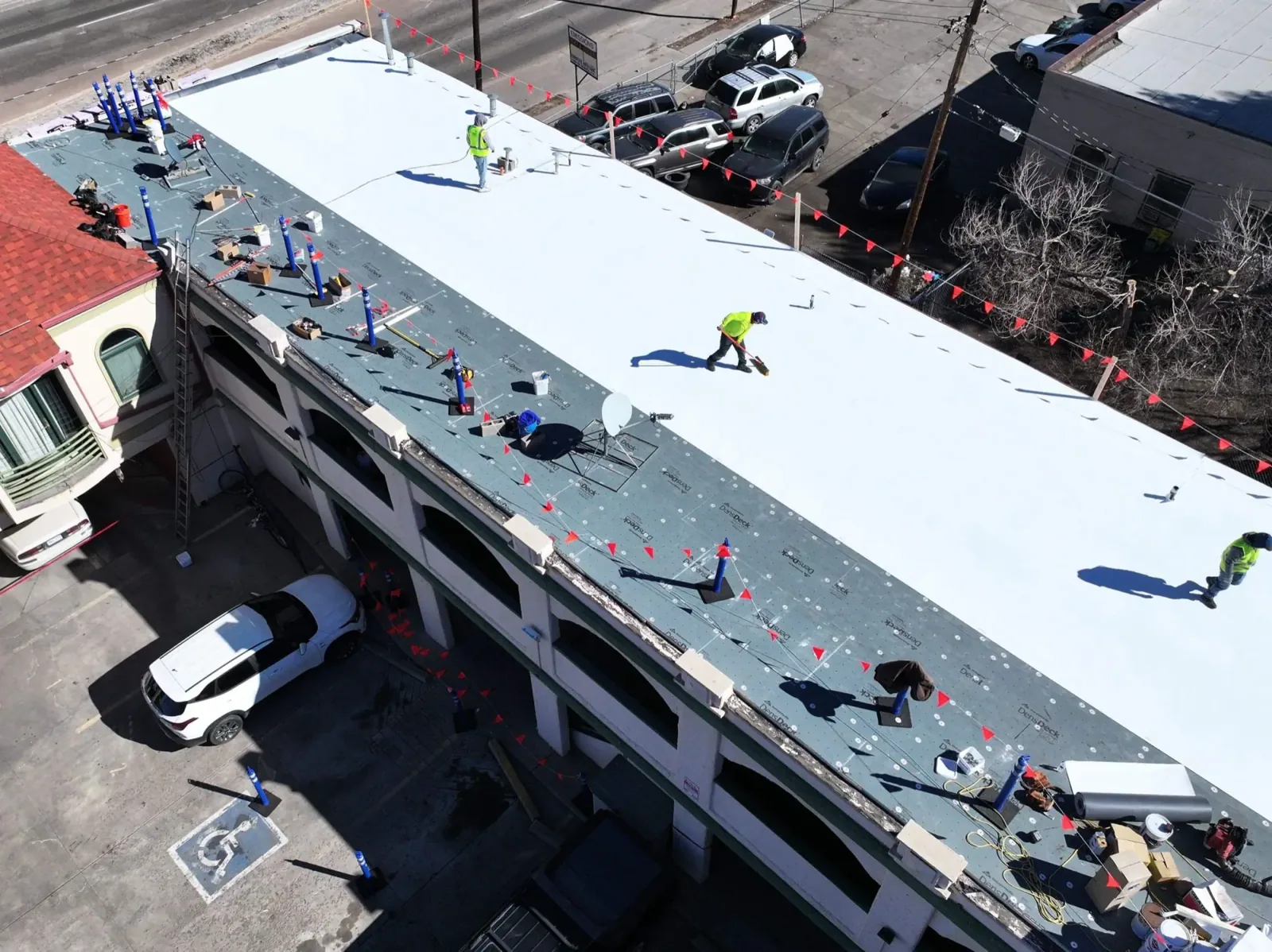
The answer to every one of those risks is the same. Work in sections small enough to finish and seal in a single day. We tear off only the area the crew can dry in before it quits, tie the new membrane to the old edge, and leave the roof watertight each night.

For dust, we protect the ceiling plane where it matters. That can mean a dust barrier at the deck, vacuum cutting of the old layers, and bagging debris on the roof in place of dropping it down a chute. For air, we coordinate any required intake isolation with the HVAC team during an approved shutdown window, preserving ventilation requirements, and we pick low-odor adhesives or mechanically attached systems where the schedule allows.

For access, we agree on a path before the first day. That includes where the crew parks, where materials are staged, and which entrances stay open. A covered walkway protects the doors people use. Fall protection and overhead protection are set at each side of the building, not just where the crew is working.

When the owner wants the least disruption, a roof recover over a sound existing roof avoids the tear-off altogether. Confirmed wet materials need removal, and widespread deterioration may require commercial roof replacement, and the phasing carries the load.

What tenants will notice

What tenants will notice

A good plan names these items before day one, and tells tenants what to expect:

  • Noise windows, with the loudest steps set for the hours that cost the least.
  • Parking and loading zones that move as the work moves around the building.
  • Which HVAC controls or shutdowns are approved, their timing and the ventilation arrangements.
  • Roof access, ladder or stair locations, and any entrances that close.
  • Cleanup at the end of each day, including the walkways and parking areas.
  • A contact who answers when a tenant calls, and a plan for ceiling damage if it happens.

Managers who handle several buildings can run the same plan across all of them. For property management companies, a written notice gives each tenant the same plain schedule and the same phone number.

Afternoon storms set the clock

In Pinellas, the working day on a roof has a time limit. From late May into October, thunderstorms arrive on most summer afternoons, and Tampa Bay has a reputation as the lightning capital of North America. That means tear-off starts early, the dry-in finishes with margin, and the crew stops when lightning is near.

Buildings that never close make the schedule harder. Morton Plant Hospital, a 687-bed BayCare campus on the bluffs over Clearwater Bay, has pavilions from 1941 and 1966 beside newer ones, and a hospital cannot send its patients home for a roof job. Work near air intakes, operating areas and emergency entrances has to be agreed in advance, in writing. Mease Countryside Hospital, a 387-bed hospital on McMullen Booth Road, faces the same kind of planning. Our hospital roofing approach starts with the intakes and the traffic.

Retail is the other hard case. Countryside Mall is a two-level retail property with skylights. Store access and operating restrictions require agreement with the property team. At Countryside and in shopping center roofing across US 19, the work leans on early starts, protected entrances and a clean parking lot by opening time.

Pick the quiet months

Pick the quiet months

The operator identifies quieter work windows. Schools may still run summer programs, though summer is also the wet season, so a school roof crew works the morning hours. Retail work windows follow the actual store schedule. Hotels on Clearwater Beach follow a tourism calendar tied to the beach and to spring baseball, so the work moves to wings that are closed or lightly booked.

Outside the summer wet season, useful installation windows still depend on product temperature, surface dryness and curing requirements. We compare those conditions with the property's actual occupancy calendar before setting the sequence.

Hurricane season sits across all of this. If a named storm approaches, the crew secures the open section, ties down material and clears loose debris from the roof. Before a storm, the building should not be left with a half-finished edge. After one, we walk the finished and unfinished sections together.

Commercial Roofing Questions

What does a tenant do if a ceiling tile gets dusty or stained during the job?

Call the number on the notice and report it the same day. We photograph the spot, find the path, and fix the cause before the next section opens. Cleaning and ceiling repairs are part of the plan from the first day, so tenants are not left to follow up on their own.

Will the HVAC need to shut down while the roof is replaced?

Required controls depend on intake locations and the work. The HVAC team establishes any shutdown or isolation during an approved window and confirms ventilation requirements. We review material methods and staging with them; operating intakes are not arbitrarily covered.

How do you protect a ceiling grid and the people under it?

Protection starts at the deck. We work in narrow sections, vacuum or bag debris on the roof, and keep the opening small. Where the space below is sensitive, such as an exam room or server area, we add a barrier or move the work to a time when the room is empty.

Can a hospital stay fully open during a reroof?

The hospital establishes whether continued operation is practical for the affected spaces. Its team sets restricted zones, HVAC controls and emergency access requirements. We work in sections, follow infection control rules the facility provides, and stop work when the hospital asks.

What happens if a storm cell rolls in mid-job?

The work plan limits openings and provides an agreed weather response. We monitor conditions and secure work before it becomes unsafe, with suitable temporary protection available. Lightning and access hazards can prevent further roof work, so the plan must not rely on racing an approaching storm.

Plan the reroof around your people

Send photos of your roof or book an inspection. We will walk the building with you, show you what we see, and explain how the work can be phased so tenants and operations keep going.

Request a Roof Assessment   or call 555-555-5555

Call555-555-5555