Roof Drains, Scuppers and Ponding Correction in Clearwater, FL

Roof drain, scupper and cricket repair in Clearwater, FL: clogged drains cleared, overflow paths fixed and ponding corrected before the next storm.

Drains fail quietly. The sign is a puddle on the roof two days after the rain, and by then the roof has been carrying extra weight and extra wear for a long time.

A flat roof has one job after a storm: get the water off. Everything else depends on it. Roof materials have different exposure limits, and insulation below the covering should remain protected from water entry. Persistent ponding deserves investigation of drainage and assembly condition. For buildings in Clearwater, FL, where afternoon storms roll in for months, the drainage arrangement needs close inspection alongside the waterproofing.

This work is not glamorous. Cleaning and repairing an outlet have different scopes from redesigning slope. Here is how drains, scuppers and the slope around them fail, and how we fix each one.

Standing water is a load

Standing water is a load

Water is heavy. Accumulated water adds load to the roof. The support condition and drainage design require appropriate review where deflection or persistent ponding raises concern.

Weight is only the start. Water that stays on a membrane works at every seam beneath it. Sun heats it, night cools it, and the cycle weakens welds and sealants. Algae and dirt settle in the pond, and the surface below ages faster than the dry surface around it.

Deck sag makes it worse. As the deck dips, the low spot deepens and holds more water. The pond grows year by year. Why it matters: a pond is a roof problem that feeds itself. Observed deflection needs investigation rather than an assumption that each storm changes the deck elevation.

Signs a drain is failing

Most drain trouble announces itself if you know where to look. Here are the signs:

  • Water still standing near a drain two days after the last rain.
  • A ring of dirt or algae marking where the pond reaches.
  • Debris packed against a strainer, or a strainer missing altogether.
  • Staining on the wall below a scupper, which warrants investigation of discharge and connections.
  • A gurgling sound inside the building during heavy rain, which can point to a blocked line below the roof.
  • Rust or corrosion on metal strainers and drain bodies.

Any one of these is a reason to send a photo. Several signs together warrant a drainage investigation, including the pipe path where needed.

Drains first, then slope

Drains first, then slope

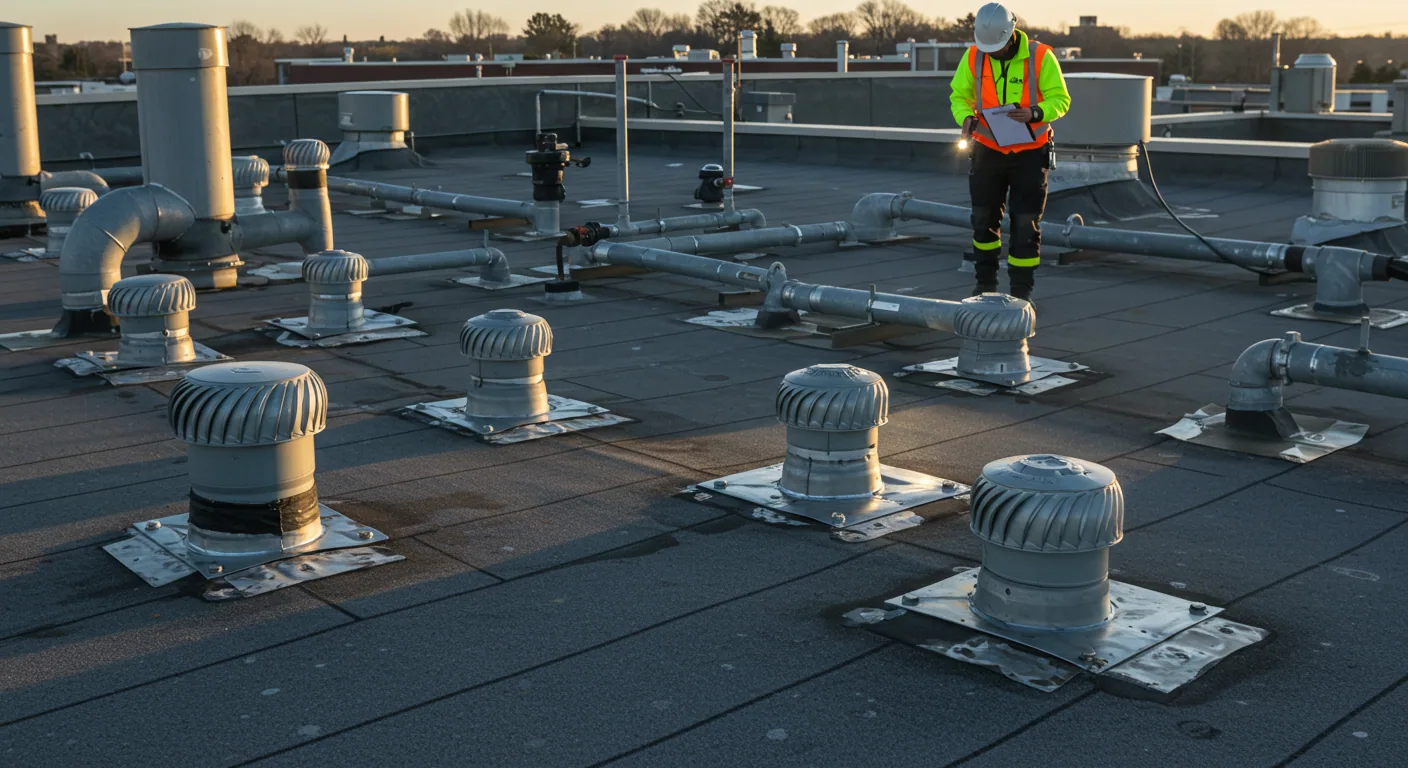
We start with the simple fixes. Strainers get cleared, sumps get flushed and debris leaves the roof. We run water through each drain to check flow, not just look at it. A drain that looks open can still be blocked in the pipe below.

Next we look at the seal. The membrane around a drain is a flashing detail, and it fails like any other. We check the clamp ring, the sealant and the edge of the membrane where it meets the drain body. A leak at a drain often shows up inside as a stain nearby, far from the actual opening. Repairs at that point are part of our commercial roof repair work.

Scuppers are through-wall outlets. We identify whether each serves primary or overflow drainage and check its intended elevation, that it is lined or flashed on all four sides, and that the water has somewhere to go once it leaves. A scupper that spills against a wall will stain and rot the wall. We add a downspout or a conductor head where needed. The metal around a scupper is edge work too, so edge metal, coping and gutters get checked in the same visit.

Crickets, saddles and slope

When water will not drain even with clean outlets, the roof needs help with slope. A cricket is a small sloped section built behind a curb or a pipe, giving water a path around the obstacle instead of a dam to sit behind. Crickets are cheap compared with the damage a pond causes, and they are standard on well-built roofs.

For wider ponds, we add tapered insulation. It builds slope into the surface so water runs toward the drain. In a replacement or a recover, the tapered insulation system can be designed from the start. On an older roof, we can add a local taper over the low spot.

Sometimes the right move is another drain. A roof with too few outlets for its area, or with a drain placed above the low point, will pond whatever else we do. Adding or relocating drainage requires a design that addresses the tributary area, elevations and downstream path. Where water persists, our ponding water repair work examines elevations and outlet conditions, with testing selected only where safe and suitable.

Rain on a schedule

Rain on a schedule

From late May into October, afternoon rain is the default here. Clearwater averages roughly 52.6 inches of precipitation a year, and most of it arrives as summer thundershowers. A drain that is half blocked in June will be tested every afternoon for four months.

The big storms test it harder. Milton's rain in October 2024 ran past 18 inches in places. In a rain like that, the primary drains can fall behind, and the overflow path takes over. Building codes call for that backup route, usually an overflow scupper set slightly higher than the main drain. If it is blocked, water rises until it finds a weak point at a parapet or a wall.

The flat land adds its own lesson. Pinellas Park sits low and flat, and the Pinellas Park Water Management District runs canals to move ground water. A roof has no canals. It has only its drains, so they must work.

Clear them before the afternoon storms

Drains should be cleared before the rainy season opens and again after it closes. Debris collects after a big wind event too, so a storm visit belongs on the calendar. Beachfront properties, such as the hotels on Clearwater Beach, also collect sand and salt that eat strainers and fasteners.

Where one roof covers several tenants, as it can at retail centers near Countryside Mall, a single blocked outlet can wet several units at once. Owners of shopping center roofs get the most from a drain check placed on a fixed schedule through preventive roof maintenance.

Cost depends on how many drains and scuppers there are, how hard they are to reach, and whether the fix is cleaning, repair or new construction. A cleaning visit is short. A slope correction is a project with a design.

Commercial Roofing Questions

Do puddles remaining between storms need a drainage visit?

Persistent water needs an examination of the outlet and the surrounding slope. A blocked drain, raised connection or low deck area requires a different correction. We record the affected location and how long the water remains so the repair addresses the cause instead of only clearing visible debris.

Why does a drain overflow when it is not clogged?

The trouble may sit below the roof. A blocked or undersized pipe backs water up even when the strainer is clear. We check accessible roof outlets and coordinate downstream line investigation with the appropriate plumbing trade.

What is an overflow scupper for?

It is the emergency exit. When the main drains fall behind, water rises to the overflow opening and leaves over the edge, instead of climbing the parapet and flooding the roof. It needs to stay clear.

Can ponding be fixed without replacing the roof?

Often. Cleaning, a new drain, a cricket or a local taper can end a pond on a roof that is otherwise sound. Deck deflection needs appropriate structural review, and wet insulation needs a defined removal scope. These findings enter the comparison rather than automatically requiring whole-roof replacement.

Do scuppers need cleaning as much as drains?

They do. A scupper is a narrow opening, and one palm frond or a handful of gravel can narrow it further. We clear them on the same visit, and we check the spot where the water lands.
Send a photo of the puddle

Send photos of any standing water, stained wall or blocked drain, or book an inspection. We will trace the cause, show you what we find, and explain the fix. Call any day of the week.

Request a Roof Assessment   or call 555-555-5555

Call555-555-5555